How the Star BMS QR Code Platform Delivers Safety, Compliance and Confidence — at Every Scale
How Star BMS’s QR Code contractor management platform supports safety, compliance and governance — across large residential buildings and small townhouse schemes — with reference to Australian legislation, standards, and best practice.
The Challenge: Contractor Oversight in Strata Communities
Managing contractor access has become one of the most operationally demanding areas of building governance. Whether it is a single electrician attending a small townhouse complex or multiple trades working concurrently across a large residential tower, strata managers and committees are expected to balance safety, compliance, visibility and accountability — often with limited time and fragmented records.
The consequences of getting this wrong are real. Without a clear record of who attended site, when, and why, even routine incidents can become expensive disputes. Without a documented induction process, buildings may struggle to demonstrate that contractors understood their obligations before work commenced. And without a reliable attendance log, verifying that contracted services were actually delivered becomes difficult.
The Star BMS QR Code platform has been developed specifically to address these challenges — providing a structured, scalable and defensible solution that is grounded in Australian legislation, standards and best practice
What Is the QR Code Platform?
The Star BMS QR Code platform replaces paper sign-in books and ad hoc contractor registers with a web-based check-in, induction and compliance workflow. A QR code is displayed at the building entrance or relevant access point. When a contractor arrives on site, they scan the code using their own mobile device — no app required — and complete a structured digital process before work commences.
Each check-in captures:
• Contractor and company details — name, company, licence and trade
• Purpose of visit — specific works and location within the scheme
• Time in and time out — visit duration, automatically time-stamped
• Key usage log — declaration of any keys or access cards received or returned
• Site-specific induction — safety rules, access conditions and escalation pathways tailored to the building
• SWMS confirmation — Safe Work Method Statement acknowledgement for high-risk works
• Insurance and compliance declarations — public liability, licence currency and relevant certifications
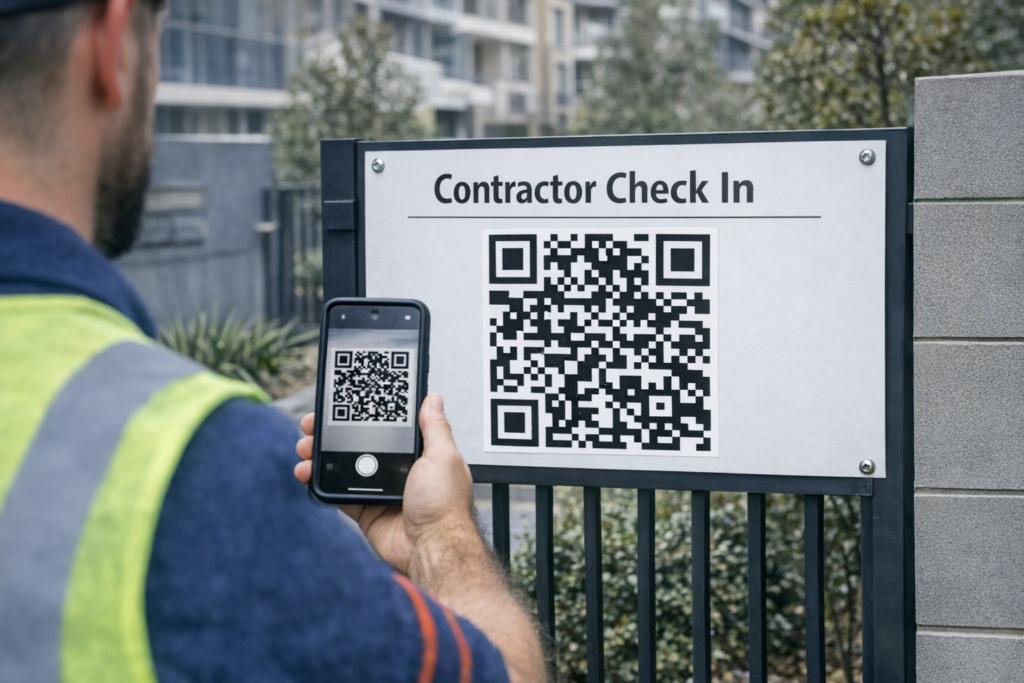
More than a sign-in — a structured onboarding process Recording who was on site is useful. Ensuring contractors understood how to work safely within that environment before starting is what satisfies duty of care. The Star BMS platform combines both in a single, seamless step.
Grounded in Australian Legislation and Best Practice
The platform has been designed to support compliance with the legislative and standards framework that applies to contractor management across Australian strata and community title environments.
Work Health and Safety Act 2011 (Cth) and state equivalents. Under WHS legislation, persons conducting a business or undertaking — which can include bodies corporate and strata managers in certain circumstances — are required to consult, cooperate and coordinate with contractors within shared workplaces. The platform’s induction component directly supports this obligation by ensuring contractors are informed of site-specific hazards, safety expectations and emergency procedures before commencing work.
Safe Work Method Statements (SWMS). The WHS Regulation 2011 requires SWMS for high-risk construction work. The platform captures contractor confirmation that a current SWMS is in place and has been reviewed prior to works commencing — creating a documented record aligned with these requirements.
AS/NZS ISO 45001:2018 — Occupational Health and Safety Management Systems. The platform reflects the principles of this standard, which promotes a systems-based approach to managing contractor risk and maintaining records. Digitising check-ins, inductions and declarations moves buildings from reactive compliance toward structured, auditable safety management.
Body corporate obligations. Across Queensland and other jurisdictions, bodies corporate retain responsibilities relating to common property safety, contractor engagement and incident prevention. The Star BMS platform provides a practical, proportionate mechanism to discharge these obligations with documented records — whether or not the body corporate technically meets the definition of a PCBU under WHS law.
References and further reading:
→ WHS Duties in a Contractual Chain — Safe Work Australia
→ Apartment Owners and Bodies Corporate — WorkSafe QLD
→ AS/NZS ISO 45001:2018 — WHS Management Systems (Comcare)
→ WHS Compliance for Building Owners and Managers — ABMA
Real-Time Notification and the Digital Contractor Register
The platform does more than capture data — it actively informs the right people at the right time. As soon as a contractor completes their check-in and induction, nominated parties receive an immediate email notification detailing who is on site, what works are being undertaken, when they arrived, and confirmation that induction and declarations have been completed.
All data is automatically stored in a digital contractor register, accessible for review at any time. This provides:
• A complete audit trail of every contractor visit, induction and compliance declaration
• Frequency monitoring — identifying contractors who attend regularly versus those who attend on an irregular or ‘hit and miss’ basis
• Service verification — comparing attendance records against invoices for recurring maintenance contracts
• Incident support — providing factual, time-stamped records when disputes, damage or access issues arise
Aligned with best-practice record keeping Safe Work Australia’s Codes of Practice consistently reference contractor management records as part of effective WHS systems. The digital contractor register delivers exactly this — without the administrative burden of manual systems.

Works for Any Scheme — Large Buildings and Small Complexes
One of the most important aspects of the platform is that it is proportionate and scalable. It is not a tool designed only for large buildings with dedicated facilities teams — it works equally well for small townhouse complexes managed remotely.
For large residential and mixed-use buildings, the platform provides consistent contractor onboarding across site, oversight of multiple concurrent trades, and real-time visibility of high-frequency or irregular contractors — creating an auditable register that supports WHS obligations in complex shared workplaces.
For smaller townhouse complexes and low-density schemes, the platform offers a light-touch but defensible control. No dedicated on-site staff are required — the contractor completes the process independently on their own device, and the committee or manager is notified immediately regardless of their location. Informal sign-in practices are replaced with a documented, repeatable process that builds a governance record over time.
The result is disproportionate governance value relative to the minimal effort required of contractors and managers — at every scale.
Examples of these can be found in our case studies here.